Imagine a child waking up in the morning excited to learn science.
Not because there’s a test.
Not because it’s in the syllabus.
But because today might involve robots, space, experiments, or questions that don’t have just one right answer.
For many children, science starts with curiosity — Why does this happen? How does that work? What’s inside this?
Somewhere along the way, it often turns into memorising formulas, finishing chapters, and worrying about marks. The wonder quietly takes a backseat.
But what if, just for a few days, science felt different?
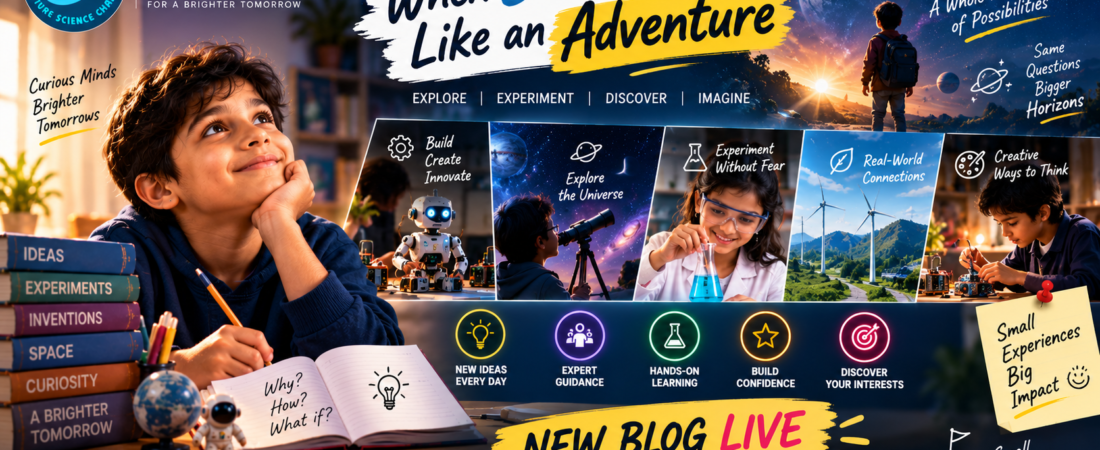
What if learning science felt more like an adventure than a class?
When learning has a beginning, middle, and excitement
Children don’t always need long-term commitments to fall in love with a subject. Sometimes, all it takes is a short, immersive experience — one that is focused, varied, and thoughtfully designed.
A five-day science journey can do something powerful:
- It introduces new ideas every day, keeping curiosity alive
- It allows children to explore without the fear of “getting it wrong”
- It gives them space to ask questions, experiment, and imagine
One day might spark interest in how machines think.
Another might open their minds to stars, planets, and life beyond Earth.
Another might show them that science isn’t just equations — it can be creative, playful, and expressive.
In such an environment, children don’t feel like they are “studying science.”
They feel like they are discovering it.
Why variety matters more than depth
For students between Grades 6 and 12, exposure is just as important as expertise.
Not every child knows what excites them yet — and that’s completely okay.
A short, well-structured science experience that touches multiple themes helps students:
- discover what genuinely interests them
- connect classroom concepts to real-world ideas
- build confidence in asking questions and thinking independently
Parents often notice something subtle after such experiences.
Children start talking — about what they learned, what surprised them, what they want to know next. That conversation is where real learning begins.
Learning that feels guided, not overwhelming
An adventure doesn’t mean chaos.
The most meaningful learning experiences balance excitement with structure.
When sessions are guided by educators and experts, when activities are age-appropriate, and when students interact rather than just listen, learning becomes both engaging and reassuring — for students and parents alike.
A short science journey works best when:
- it is interactive, not one-sided
- it respects different age groups and learning speeds
- it encourages participation rather than performance
This kind of design allows students to explore freely while still feeling supported.
A small journey can leave a lasting impact
Five days may seem short.
But the right five days can change how a child looks at science.
It can turn hesitation into curiosity.
Curiosity into confidence.
And confidence into a desire to learn more.
Sometimes, the goal isn’t to teach everything.
It’s to remind children that learning can still feel exciting.


